
Font Size:

A majority of MVEA’s costs are tied to purchasing power from Tri-State. Those costs are influenced not only by how much electricity is used, but also when it is used and the demand placed on the system. Much of our cost as an electric cooperative is now driven by our peak demand, not our total energy use. Aligning rates with those costs helps keep rates fair and more stable for all members.
What’s Changing?
Rate Comparison Tool
Use the Rate Comparison Tool to see how your bill may have looked under each new rate based on your recent energy use. Compare your options and choose the best rate that fits your lifestyle. This tool helps you make an informed decision based on your actual use history (April 2025 – April 2026).
This tool is only available for Residential and Small Power members. Net Metering accounts are not yet available.
MVEA has been discussing rate pressures and possible changes since early 2023 in Colorado Country Life Magazine, community events, member meetings, and more. Below are recent communications about MVEA’s 2026 rate changes.
Residential members may select from two rate options to the best fit for their lifestyle: the default Demand Rate or the Time-of-Day Rate.
Members may change their rate selection anytime, once every 12 months after first enrollment, beginning August 1, 2026.
Members can request the change in SmartHub or by calling our Member Services department at (800) 388-9881.
To request the change in SmartHub:
1. Log in to SmartHub.
2. Select Usage from the left navigation and then Usage Explorer.
3. On the Usage Explorer screen:
4. Select the date range.
Important: The Interval view can only display 30 days at a time.
5. Look for the highest demand value in the table below. This shows the highest demand interval recorded during the selected period.
Net Metering Members:
This will show Consumption on the graph instead.
To provide billing consistency and help members accurately evaluate how a rate fits their household over time, rate selections remain in effect for 12 months after first enrollment before another change can be made.
Yes. Most Colorado co-ops and municipals already have demand charges, Time-of-Day pricing, or both.
No. The charge is tied to one peak interval each billing cycle.
Yes. A new billing cycle creates a new peak demand measurement window.
It will appear as its own line item.
These members will only see a slight increase in the kWh charge.
These members will be enrolled in and remain on this rate while they utilize prepaid billing. Other rate options become available when standard billing is selected.
To request the change in SmartHub:
Large Power members will see a Time-of-Day Demand charge added to their monthly bill. This charge will be for their highest 15-minute period of use during the month, Monday–Friday, 5 p.m. – 9 p.m. The existing demand charge for the highest 15-minute period set at any time during the month will remain but will be reduced from the current amount.
Net Metering members will default to the Net Metering Demand Rate. During daylight hours, solar production can reduce the amount of electricity you draw from the grid, lowering your demand. However, demand at other times – such as evenings or when solar is not producing – will be based on your usage during those periods and is not offset by earlier solar generation.
Net Metering members will also have two options including the Net Metering Demand Rate or the Net Metering Time-Of-Day Rate.
Changes to the Irrigation rate include the introduction of an annual Grid Access charge and a Demand charge (highest 15-minute interval anytime Monday – Saturday), along with a three-year phase-out of the existing Horsepower charge. Members may pay the annual Grid Access fee up front or it will be automatically assessed on their monthly bill. There will no longer be a minimum annual charge based on horsepower.
These accounts will now be billed a Time-of-Day Demand charge (highest 15-minute interval between 5 p.m. and 9 p.m., Monday – Friday) in addition to a reduced version of the existing Demand charge (set at any time, Monday – Sunday).
The new Member-Owned and Maintained Lighting Rate will allow municipalities, special districts, and homeowners’ associations to own and maintain their preferred outdoor lighting fixtures with MVEA providing power at a fixed monthly rate.
No. Net metering remains in place. The primary changes are related to how the account is billed.
The Net Metering rates were designed so members continue receiving net metering credits while also reflecting the requirements placed on the electric system. This approach helps keep the program fair and sustainable for all members while preserving the benefits of net metering.
Net metering accounts are unique because they both consume electricity from the grid and export electricity back to the grid. Because these accounts include banked energy credits, they require a billing structure that can continue applying those credits while also accounting for factors such as demand or time of generation.
Residential Net Metering members may elect either the Net Metering Demand Rate or the Net Metering Time-of-Day Rate.
There is no single rate that is best for every member. The impact of each rate option depends on factors such as when your solar system generates electricity, when your household uses electricity, and whether you have technologies such as batteries or electric vehicles. MVEA provides educational resources and rate comparison tools to help members make informed decisions.
No. Existing net metering members will transition to one of the available net metering rate options in accordance with MVEA’s rate transition process. Net metering itself is not going away, and members will continue receiving credits for excess solar generation.
Solar can continue to reduce the amount of energy you purchase from the grid and help lower your energy charges. Members who use power during solar-producing hours may see additional benefits because they are using their own generation in real time.Under the Net Metering Time-of-Day Rate, the value of solar may also depend on when electricity is generated and when electricity is used because On-Peak and Off-Peak credits are maintained separately.
Yes. Your solar production will continue to offset the energy you use from the grid. If you generate more electricity than you use during a billing period, those excess kWh credits will continue to be banked and applied to future energy charges.
Your solar system will continue to reduce the amount of energy you purchase from the grid and will continue to earn net metering energy credits. The purpose of the rate change is not to remove those energy credits. It is designed to better reflect both the energy a member uses and the requirements placed on the electric system.
No. Solar remains an effective way to offset energy use. The net metering program remains in place, and members will continue receiving one-for-one energy credits for excess generation under both available net metering rate options.
No. Even with solar and battery storage, most members continue to rely on the electric grid for reliable service during extended periods of high use, cloudy weather, winter conditions, or when battery storage has been depleted. The grid remains available whenever additional electricity is needed.
Energy, measured in kWh, is how much electricity you use over time. Demand, measured in kW, is how much electricity you need at one time. A helpful way to think about it is distance versus speed. Energy is like the total distance driven, while demand is like the fastest speed reached during the trip. Both tell you something different about how the system is used.
The Net Metering Demand Rate was designed so members can continue receiving net metering credits while also reflecting the demand placed on the electric system.
Even with solar panels, your home still relies on MVEA’s electric system when your electricity needs are greater than what your solar system is producing. The demand charge helps recover the cost of maintaining the capacity needed to provide reliable service whenever electricity is needed.
You will still receive one-for-one credit for the net energy you export back to the grid, but those credits will only apply to the kWh energy portion of your bill. These banked credits will not offset your demand charges. The final bill will include your grid access fee, net energy use, and highest single one-hour demand charge for the month.
Your demand charge is based on the highest amount of electricity you use during any single one-hour period in the billing cycle. It is not based on your total monthly energy use alone.
Yes. Your demand charge is based on your highest one-hour use during the billing cycle. Even if that higher-use period happens only once, it will still set your demand charge for the month.
That is why spreading out large appliances can make a difference. The goal is to avoid creating one unusually high-use hour.
This can be confusing because solar generation and demand are measured differently. Solar production may help reduce the electricity you need from the grid during some hours of the day, but demand is based on your highest one-hour use period. If that hour occurs when solar production is low or several large appliances are running at once, you may still have demand.
The impact of the new rate depends on each member’s use patterns. Some members naturally have use patterns that result in lower demand, while others may have periods when several large appliances operate at the same time. As a result, some members may see lower bills, some may see little change, and others may see an increase.
For net metering members, solar energy credits will continue to offset energy charges, but demand charges are based on the highest one-hour use during the month. Every member’s experience will be different depending on how and when electricity is used.
Banked energy credits can be applied to the energy portion of your bill because they are measured in kWh and net metering credits are issued on a one-for-one basis. Demand charges are calculated differently and therefore cannot be offset by accrued energy credits.
Managing your demand charge is most effective when you spread out large electrical loads instead of using several at the same time. Solar generation can provide more flexibility by allowing you to use appliances during solar-producing hours and avoid the need to run those same loads later when your system is not producing as much.
Remember, your demand charge is determined by your highest one-hour use period. If several large appliances are operating during the same hour, that hour could establish your monthly demand charge. Example: If you charge your electric vehicle, run the dryer, and use the oven during the same hour, that period may become your highest demand hour for the month.
The goal is to avoid using several large appliances at the same time. Your demand charge is based on your highest one-hour use, so spacing out EV charging, laundry, cooking, and air conditioning may help lower your monthly demand. For solar members, using larger appliances during daylight hours may provide an added benefit because your solar system may be producing electricity at that time. This can help you use more of your own solar energy directly, even though the demand rate itself is the same day or night.
Think of it this way: demand is less about when you use electricity and more about how much electricity you use at the same time.
Large appliances running at the same time can increase demand. The more loads that operate during the same hour, the more likely that hour is to become your monthly peak.
The easiest approach is to avoid stacking large electrical loads and running them at the same time. For example, charging an EV, running the dryer, and cooking dinner during the same hour may create a higher demand than doing those activities at different times. A good sign that you are managing demand well is having fewer periods when multiple large appliances are running together.
It may be possible to reduce your demand charge, but most homes will still have some demand because nearly every household has periods of higher use.
The goal is to avoid creating one unusually high-use hour when several large appliances are running at once.
Yes. We understand that this can be surprising because many solar members are accustomed to focusing primarily on their net energy use. However, energy and demand measure different things. Even if your solar system offsets all or most of your monthly energy use, your demand charge is based on the highest amount of electricity your home requires during a single one-hour period.
Electric vehicle chargers are often one of the largest electrical loads in a home. If your EV is charging while other large appliances are operating, it may contribute to a higher demand charge.
Many members can manage demand by scheduling EV charging when fewer appliances are running or by reducing the vehicle charging rate if their charger has that capability.
If your solar system is producing, charging your EV during the day may help you use more of your own solar energy. Avoid charging while multiple large appliances are running, as that could still increase your demand.
Overnight charging may still make sense for many households. The key is to avoid stacking EV charging with other large loads during the same hour.
For example, if your EV charges overnight, try not to run other large electric loads at the same time if you can avoid it. If your charger allows you to lower the charging speed, that may also help reduce your peak.
A battery may help, depending on your use patterns, battery size, and how the battery is operated. In some situations, a battery can provide power during higher-use periods and help reduce demand. However, it may not eliminate your demand charge completely because most homes still have times when electricity use is higher.
No. Even with solar and battery storage, most members continue to rely on the electric grid for reliable service during extended periods of high use, cloudy weather, winter conditions, or when battery storage has been depleted.
The grid remains available whenever additional electricity is needed.
Electric vehicles, solar systems, and batteries can all provide benefits when they are used in ways that reduce strain on the electric system. A demand charge does not remove those benefits.
The demand charge reflects the amount of electricity your home requires during your highest-use period. Members who use batteries, charge EVs strategically, or use solar energy directly in their homes may have more opportunities to manage demand than members without those technologies.
No. The Net Metering Demand Rate is not based on whether a member owns solar. It was designed so members can continue receiving net metering credits while also reflecting the demand placed on the electric system.
Solar members continue to receive energy credits for excess generation. The demand charge reflects the electric capacity needed to serve members during periods of higher use.
It can, especially when your home is using electricity while your solar system is producing. However, your demand charge is based on your highest one-hour use during the month, which may occur when solar production is low or when several large appliances are running at once.
Many people assume that using less total electricity automatically means a lower demand charge. In reality, demand is based on how electricity is used.
Two members could use the same number of kWh during a month but have different demand charges if one member uses several large appliances at the same time and the other spreads use more evenly.
You will continue to receive one-for-one energy credits for electricity your solar system sends back to the grid. The difference is that separate energy credit balances are maintained for On-Peak and Off-Peak periods.
Energy generated during On-Peak hours offsets On-Peak usage, while energy generated during Off-Peak hours offsets Off-Peak usage. Credits from one period cannot be used to offset usage in the other period.
Yes. The Time-of-Day Net Metering Rate continues to provide one-for-one energy credits for excess generation. The primary difference is that credits are tracked separately between On-Peak and Off-Peak periods.
On-Peak hours are Monday through Friday from 5:00 PM to 9:00 PM, excluding certain holidays.
All other hours are considered Off-Peak.
The Time-of-Day Rate recognizes that electricity has different costs at different times of the day.
To support that structure, energy credits are tracked separately. Electricity generated during one time period offsets electricity used during that same time period.
No. On-Peak and Off-Peak credits are maintained separately. Credits earned during one time period may only offset use incurred during that same time period.
This is one of the most common questions we expect to receive.
Under the Time-of-Day Net Metering Rate, On-Peak and Off-Peak credits are maintained separately. A member may have available Off-Peak credits while still owing for On-Peak energy if there are not enough On-Peak credits available to offset that usage.
Existing accrued energy credits will be settled as a credit on the member’s account at MVEA’s current Avoided Wholesale Energy Charge before enrollment in the Time-of-Day Net Metering Rate.
Once the new rate becomes effective on your account, and following settlement of any accrued credits, the existing bank will be closed and separate On-Peak and Off-Peak credit banks will be established.
Most residential solar systems produce the majority of their energy earlier in the day.
Because On-Peak hours occur from 5:00 PM to 9:00 PM, many solar members will naturally accumulate more Off-Peak energy credits than On-Peak energy credits.
The Time-of-Day Net Metering Rate continues to provide one-for-one energy credits for excess generation. The primary change is that On-Peak and Off-Peak energy credits are tracked separately. The impact on any individual member depends on when electricity is generated, when electricity is used, and how much usage occurs during On-Peak hours.
Members who can shift some energy use outside of the On-Peak period may reduce the amount of On-Peak energy they need to purchase from the grid. Solar members may also benefit from using larger appliances during solar-producing hours when practical.
A battery may allow you to store solar energy generated earlier in the day and use it during the On-Peak period. Depending on your usage patterns and battery configuration, this may help reduce On-Peak energy purchases.
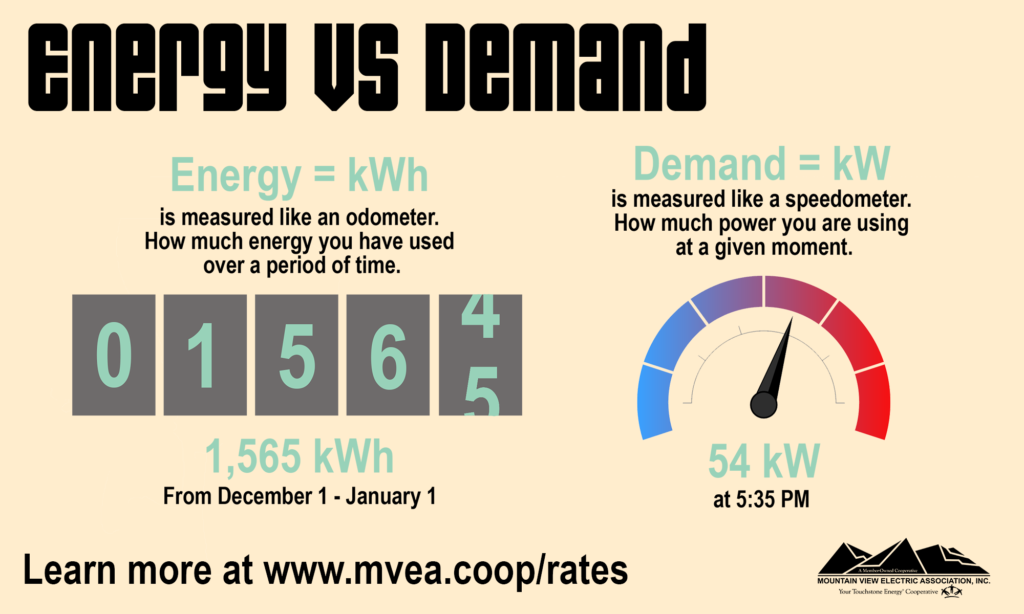
You can help lessen our costs and reduce peak demand by spreading your use of electricity throughout the day, as opposed to using energy all at once.